
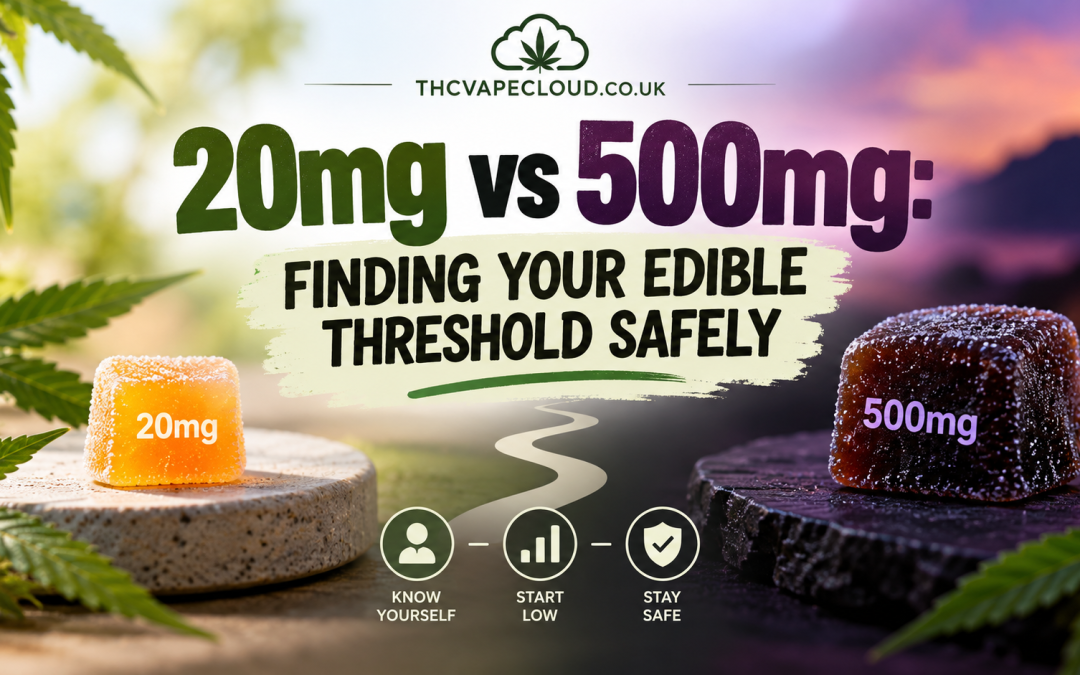
20mg vs 500mg: finding your edible threshold safely
20mg vs 500mg: finding your edible threshold safely starts with one essential distinction: the number on a THC edible can mean the amount in one piece or the total amount in a package. Neither number tells you what will suit you personally, and a 500mg label should never be mistaken for a single serving without checking the dose label.
Key Takeaways
| Question | Short answer |
|---|---|
| Is a 20mg edible enough to feel high? | Effects vary. A single 10-milligram gummy can feel overwhelming for someone with little or no THC tolerance, according to Northwell Health. |
| Does 500mg usually mean one edible? | No. It may refer to the package total. Find the THC amount per serving and the number of servings before consuming any. |
| How should a new or unfamiliar edible be approached? | Choose a clearly labelled product, use a very small amount, and follow a low-and-slow approach rather than taking more quickly. |
| How soon can an edible take effect? | Onset is delayed and variable. Do not use the absence of an early effect as a reason to take more. |
| Can body weight predict the right THC dose? | No. Weight alone cannot reliably determine an individual response. |
| What should you do after taking too much? | Stay with a trusted sober person, avoid driving and other substances, and get urgent medical help for severe symptoms. |
20mg vs 500mg: what the numbers actually mean
20mg and 500mg are amounts of THC, not equivalent measures of a standard edible serving. A label stating 20mg per piece describes that piece, while 500mg may describe the total THC across a whole package.
Numerically, 500mg is 25 times 20mg, but that comparison is useful only when both figures refer to the same thing. If one is a piece amount and the other is a package total, the numbers cannot tell you how much THC is in each piece.
Before consuming anything, look for these details on the label:
- Total THC per package: the amount across all pieces or servings.
- THC per serving: the amount the label assigns to one portion.
- Servings per package: how many portions the total is divided into.
- Serving size: the amount of food that counts as one portion.
For example, if a hypothetical pack contains 500mg of THC across 10 equal servings, the arithmetic gives 50mg per serving. That example does not make the serving safe or suitable; it shows why the package total and the individual dose must be read separately.
If the label does not clearly explain the serving amount, or the edible is homemade or unfamiliar, do not guess. Unevenly distributed THC can also make two pieces of the same size deliver different amounts.
Is a 20mg edible a beginner dose?
The effects of a 20mg edible vary from person to person. A single 10-milligram gummy can feel overwhelming for someone with little or no THC tolerance, according to Northwell Health; another person’s tolerance does not establish what will be comfortable or safe for you.
For edible products, the Government of British Columbia advises starting with 2.5 mg of THC or less. This is cautious general guidance, not a personalised prescription or a guarantee that a given amount will feel mild.
Start with 2.5mg of THC or less; a 10mg gummy can feel overwhelming with little or no THC tolerance.
Source: Government of British Columbia
When assessing 20mg vs 500mg, focus on the THC per serving rather than the product name or package total. If you are new to edibles or changing to an unfamiliar product, choose a clearly labelled option and avoid taking more during the same occasion because the effects seem slow to appear.
How long do THC edibles take to work?
A 500mg label does not mean an edible will kick in faster. The onset time varies by person and product; the Northwell Health says edibles take 30 to 90 minutes to kick in, with effects peaking several hours later.
Effects may not be felt for two hours and can take four hours to peak, according to the Government of British Columbia. This delay is why taking another portion too soon can lead to unexpectedly intense effects.
The intoxicating effects of edible cannabis can last up to 12 hours, and some residual effects can last up to 24 hours, Government of British Columbia also advises. Plan to remain somewhere safe, and do not drive, cycle, operate machinery, or do other safety-sensitive tasks while affected.
Edibles differ from smoking or vaping because the effects of inhaled cannabis are felt almost immediately and typically fade sooner, while an edible must be digested before its effects are felt. Do not use your response to smoking or vaping as a reliable guide to how a THC dose in food or drink will affect you.
Why the same THC dose affects people differently
There is no universal edible threshold. Two people who consume the same labelled THC amount can have different experiences, and your own response can change from one occasion or product to another.
Factors that can influence the onset time and intensity include:
- Tolerance and experience: regular THC use may affect response, but inhaled-use experience does not guarantee tolerance to edibles.
- Metabolism and digestion: these vary between people and can affect how quickly an edible is processed.
- Product type and formulation: gummies, baked goods, drinks, and homemade foods may be absorbed or portioned differently.
- Food and stomach contents: eating patterns can affect timing, but they do not provide a reliable way to predict or control the experience.
- Health, medicines, and other substances: health conditions, prescribed medicines, alcohol, and other intoxicating substances can change safety risks.
Body weight does not provide a reliable formula for calculating an edible dose. Weight-based charts may look precise, but they cannot account for all the factors that shape an individual response.
If you take prescribed medicine, have a relevant health condition, or are unsure about interactions, speak with a qualified clinician or pharmacist before using THC. Do not stop or change a prescribed medicine to accommodate an edible.
How to reduce the chance of overconsumption
A cautious approach is more useful than trying to find a personal threshold by taking progressively larger amounts. We recommend treating each unfamiliar edible as a new product, even if you have used THC in another form.
- Read the full dose label. Identify THC per serving, servings per pack, and the package total before opening or portioning the edible.
- Use only a verifiable product. Avoid homemade or unlabelled edibles when you cannot establish their THC content or how evenly it is distributed.
- Take a small amount and wait. Follow low-and-slow principles, and do not take more simply because you feel nothing at first.
- Keep the setting safe. Stay somewhere familiar, avoid responsibilities that require coordination or judgement, and consider having a trusted sober person nearby.
- Avoid combinations. Do not mix THC edibles with alcohol or other intoxicating substances, which can make impairment and unwanted effects harder to manage.
- Do not drive while affected. Arrange transport in advance and wait until you are fully unimpaired before driving or doing safety-sensitive tasks.
Possible adverse effects after taking more THC than intended include anxiety, panic, confusion, dizziness, nausea, vomiting, sleepiness, impaired coordination, and a racing heartbeat. A strong or frightening reaction can feel distressing even when it passes, so reduce stimulation and remain with a calm, trusted person.
What to do if you accidentally eat too much
If you think you have consumed far more THC than intended, do not take more. Stay with a trusted sober person, move to a calm and safe place, and avoid alcohol, other drugs, driving, and operating machinery.
Keep the packaging available so you can tell a health professional what product and amount may have been consumed. Do not try to counteract the effects with another substance, and do not induce vomiting.
Seek emergency medical help or go to A&E if the person has severe symptoms such as difficulty breathing, chest pain, a seizure, collapse, becomes unresponsive, or cannot be woken. If the person is stable but you are concerned, seek urgent medical advice.
Stay with the person and watch for changes while seeking advice. If they become difficult to wake or their breathing becomes abnormal, treat it as an emergency and seek emergency help.
Store edibles safely around children and pets
Keep THC edibles in their original packaging, clearly separated from ordinary food and sweets, and locked away out of sight and reach of children and pets. Do not leave an edible on a table, in a handbag, or somewhere a child or animal could investigate.
After using an edible, return the remaining product to secure storage immediately. If a child or pet may have eaten one, contact urgent medical or veterinary advice promptly, and seek emergency medical help if a person develops severe symptoms.
Frequently Asked Questions
Can eating a meal or drinking water sober me up after an edible?
No meal or drink reliably reverses THC intoxication or makes it safe to drive. Sip water if you are thirsty, but rely on time, a safe setting, and support from a sober person rather than a supposed quick fix.
Can I drink coffee to feel less impaired by a THC edible?
Coffee does not remove THC or restore judgement and coordination. It may also make some people feel more restless or uncomfortable, so avoid using caffeine as a way to counteract an edible.
Can I split a homemade brownie into equal pieces to measure the THC?
Equal-sized pieces do not guarantee equal THC amounts because an infusion may not be distributed evenly through the mixture. Without reliable information about the total THC and its distribution, you cannot calculate a dependable dose from the size of a slice.
Should I take an edible on an empty stomach?
An empty stomach is not a dependable way to make an edible act faster or more predictably. Do not use fasting or a large meal as a dosing method, and avoid taking additional THC to compensate for a delayed effect.
Can I sleep after taking more THC than intended?
If the person is alert, breathing normally, and not experiencing severe symptoms, a calm rest may help them remain comfortable, but a sober person should stay nearby. Seek emergency help if they become unresponsive, cannot be woken, have a seizure, or develop breathing problems.
How do I know when it is safe to drive the next day?
Do not rely only on sleep or a set number of hours to decide. Residual impairment can continue after the strongest effects fade, so drive only when you are fully unimpaired and able to respond normally.
Conclusion
20mg vs 500mg: finding your edible threshold safely means checking whether the number refers to one serving or the whole package, then recognising that no label can predict your personal response. The effects of a 20mg edible vary from person to person, while a 500mg package total may cover multiple servings; read the dose label, use a cautious low-and-slow approach, and never redose just because the onset is delayed.
Keep THC edibles away from children and pets, avoid combining them with alcohol or other intoxicating substances, and do not drive while affected. If overconsumption causes severe symptoms, seek emergency medical help; if you are concerned but the person is stable, seek urgent medical advice.