
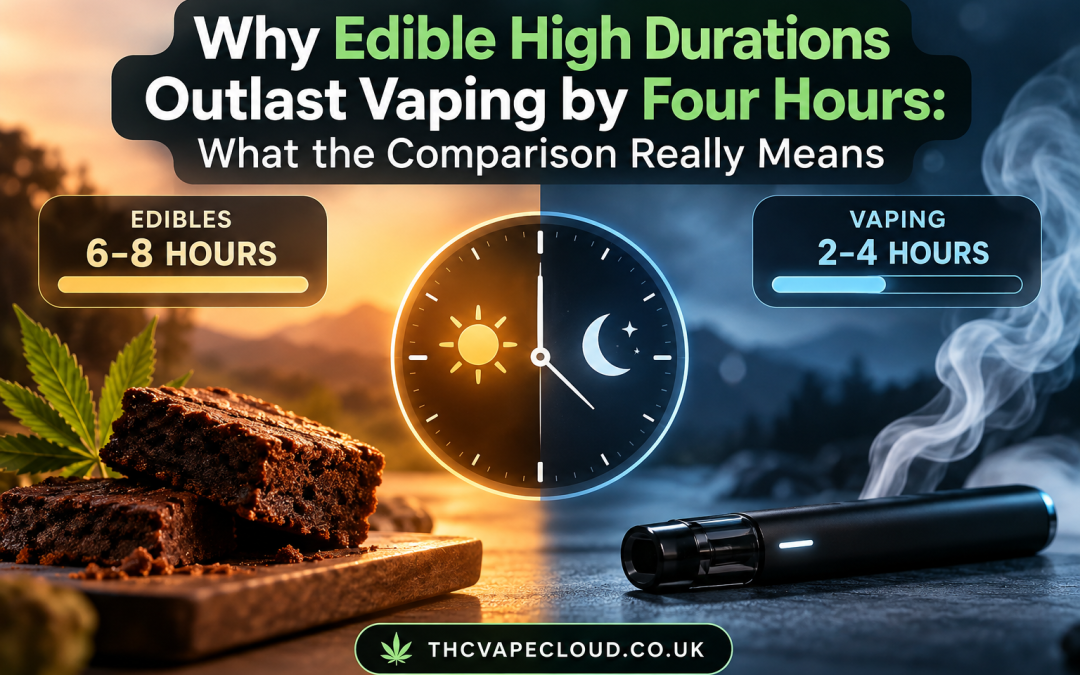
Why edible high durations outlast vaping by four hours: what the comparison really means
Why edible high durations outlast vaping by four hours comes down largely to how the body absorbs and processes THC. The difference describes a broad comparison, not a guarantee that every edible lasts exactly four hours longer than every vaping session.
Key Takeaways
| Question | Practical answer |
|---|---|
| Why does an edible take longer to work? | Swallowed THC must pass through digestion and the liver before reaching the wider circulation. |
| Why can an edible high last longer than a vaping high? | Oral processing creates active metabolites and a slower, more gradual course of effects. |
| Does the four-hour difference apply to everyone? | No. Dose, tolerance, food, metabolism and individual sensitivity all affect the timeline. |
| What should I compare on an edible package? | Read the THC amount per serving separately from the total THC or cannabinoids in the package. |
| What if I do not feel an edible yet? | Delayed onset is common, so an early lack of effects is not a dependable sign that more is needed. |
| When is it safe to drive? | Wait until you are fully unimpaired. The end of a noticeable high does not prove that reactions have returned to normal. |
For a route-by-route comparison, we have separate collections of THC edibles UK, including THC gummies, and THC vapes UK. The key difference for timing is whether THC is swallowed or inhaled.
Compare onset and duration, not just the clock
Inhaled THC can be felt within minutes because it passes from the lungs into the bloodstream. A swallowed edible commonly takes 30 minutes to 2 hours to produce noticeable effects, as it must move through the digestive tract before THC reaches circulation.
Inhaled effects often rise and fade sooner, while edible effects can build gradually and remain noticeable for longer. For a practical baseline, Medical News Today reports that edible effects may last 6 hours or more, compared with up to 4 hours after smoking or vaping.
Use the comparison to set expectations, not to predict an individual high. The “four hours longer” framing is a rough contrast between routes, not a timer that applies to every person, product or session.
Our infographic gives the same broad duration comparison. It is useful context, but it cannot predict when a particular person’s effects will begin or end.
Edibles may last 6 hours or more, versus up to 4 hours after smoking or vaping.
Source: Medical News Today
Why digestion and the liver change the experience
After you swallow an edible, THC is absorbed through the digestive tract and passes through the liver before entering the wider circulation. During this first-pass liver metabolism, some THC becomes 11-hydroxy-THC, an active metabolite that contributes to the distinct effects of an edible.
With inhalation, THC enters the bloodstream through the lungs and largely avoids that initial first pass through the liver. This helps explain why vaping can produce effects sooner, while the digestive route can take longer to start and feel more prolonged.
Not every product placed in the mouth follows the same route as a swallowed gummy or chocolate. Some lozenges and sprays are absorbed partly through the mouth’s lining, so sublingual absorption can produce a different onset and duration from an edible that is swallowed.
In other words, format alone does not tell you the whole story. Whether THC is swallowed, absorbed through the mouth or inhaled changes how it enters the body and how quickly its effects may be felt.
Four hours is a comparison, not a personal forecast
A noticeable high can fade before fatigue, slowed reactions or other impairment has fully passed. Do not use the end of euphoria as proof that you can drive, operate machinery or do another safety-sensitive task safely.
The Government of British Columbia says the intoxicating effects of edible cannabis can last up to 12 hours. That is an upper-end possibility, not a standard duration for every person or dose.
Delayed onset can also make the eventual intensity difficult to judge at first. Someone may feel little early on and then experience stronger effects later, so the first few minutes or hours do not reliably show how intense the full experience will become.
For that reason, edible high duration and lingering impairment are not quite the same question. A person may feel less intoxicated while still being tired or slower to react, so judge safety by full recovery rather than by the clock or a fading sense of euphoria.
Dose, tolerance, food, and the person all matter
A higher THC dose tends to produce stronger or longer-lasting effects, while tolerance can change how strongly a person experiences a given dose. Neither factor makes the duration exact: two people can respond differently to the same amount, and one person can have different experiences on separate occasions.
Food in the stomach, digestion speed and metabolism can all influence when an edible begins to take effect and how long its effects remain noticeable. Body composition and individual sensitivity can also shape the experience.
Vaping is faster to take effect, but its duration varies too. THC concentration, how much is inhaled, session length and tolerance can change the course of a vaping high; disposable vapes still deliver THC by inhalation, so the device format does not make every session identical.
CBD does not produce the same intoxicating effects as THC. A product containing both cannabinoids can still cause THC-related intoxication; CBD does not cancel THC’s effects.
Separate THC per serving from THC per package
When reading an edible’s potency information, distinguish the amount in the portion being consumed from the total across the package. The per-serving figure helps describe that portion, while the package total describes all portions together.
Camino Blackberry Dream Sours 1:1:1 Gummies, priced at £15.00, provide a clear example: each gummy lists 10mg THC, 10mg CBD and 10mg CBN, while the 10-count package contains 100mg of each cannabinoid in total. This distinction helps prevent a package total from being mistaken for the amount in one gummy.
For a different package-level example, Activist Edibles Orangeade Gummies 500mg cost £18 and are described as citrus-flavoured, soft-chew infused gummies with 500mg total cannabinoids per package. That total is a package figure, not a per-gummy serving figure, which is why the serving information matters when interpreting potency.
CBD alongside THC does not cancel THC’s intoxicating effects. Consider the THC amount separately when thinking about dose, expected effects and how long impairment may last.
Treat divided edibles carefully when judging a portion
A package total is not automatically the amount in one portion. When an edible is divided into pieces, use the stated portion information; the package total alone does not show the amount in each piece.
The 1000mg THC Chocolate Party Bar UK, priced at £45, contains 1000mg THC in total and is divided into pre-measured chocolate squares. Its product description presents it as intended for advanced or high-tolerance users and for group sessions, parties and sharing.
Divisions can make portions easier to identify, but they do not make the entire package a suitable single serving. Careful portion awareness matters especially with a high total potency, because taking more THC can increase both the intensity and possible duration of effects.
Reduce the risk of taking too much or staying impaired
- Do not take more just because an edible has not started working. Its onset can be delayed, and effects may continue to build over several hours.
- Avoid combining THC with alcohol or other intoxicating substances. Using them together can make impairment and unpleasant effects harder to predict.
- If the effects feel too intense, stop using THC and move to a calm, familiar setting. Ask a trusted sober person to stay with you; seek urgent medical help for severe symptoms such as trouble breathing, chest pain or loss of consciousness.
- Do not drive or operate machinery based only on feeling less high. Wait until you are fully unimpaired, since fatigue and slowed reactions can linger.
These steps matter because a long-lasting edible high can make it harder to judge recovery by sensation alone. The safest approach is to avoid adding more intoxicating substances and to leave safety-sensitive activities until impairment has fully passed.
Frequently Asked Questions
Why do I still feel high 24 hours after taking an edible?
A next-day sensation can reflect residual effects rather than the peak of the intoxicating high; the Government of British Columbia notes that some residual effects may last up to 24 hours. If symptoms are unusual, worsening or interfering with normal functioning, contact a healthcare professional for advice.
Do edibles stay in your system longer than vaping?
The length of time someone feels high is different from how long cannabis may be detectable, and the route alone does not establish a detection window. Test type, frequency of use, dose and individual metabolism all affect how long THC or its metabolites can be detected.
Can an edible hit six hours after taking it?
A pronounced change several hours after taking an edible can happen, although an onset first appearing that late is outside the common 30-minute-to-2-hour starting range. A new or concerning symptom appearing much later may have another cause; seek medical advice.
How can I tell whether a cannabis product contains THC or only CBD?
Read the cannabinoid panel for separate THC and CBD amounts, and look for a batch-specific certificate of analysis that reports both cannabinoids. A product name, flavour or CBD-forward description by itself does not establish that a formulation contains CBD only.
Can eating, drinking coffee or taking a shower sober me up faster?
No food, drink or shower reliably speeds the body’s processing of THC. Coffee or a shower may change how alert or comfortable you feel, but that sensation is not evidence that impairment has ended.
Conclusion
Why edible high durations outlast vaping by four hours is explained by the different route THC takes after swallowing: digestion and liver metabolism delay the onset and create active metabolites that contribute to a longer, distinct experience. The four-hour comparison is a broad estimate, not a personal forecast, because dose, tolerance, food and individual response all influence duration.
To compare formats responsibly, separate THC per serving from THC per package, allow for delayed effects and do not use a fading high as a signal that it is safe to drive. Those practical steps matter more than expecting every edible or vaping session to follow the same clock.